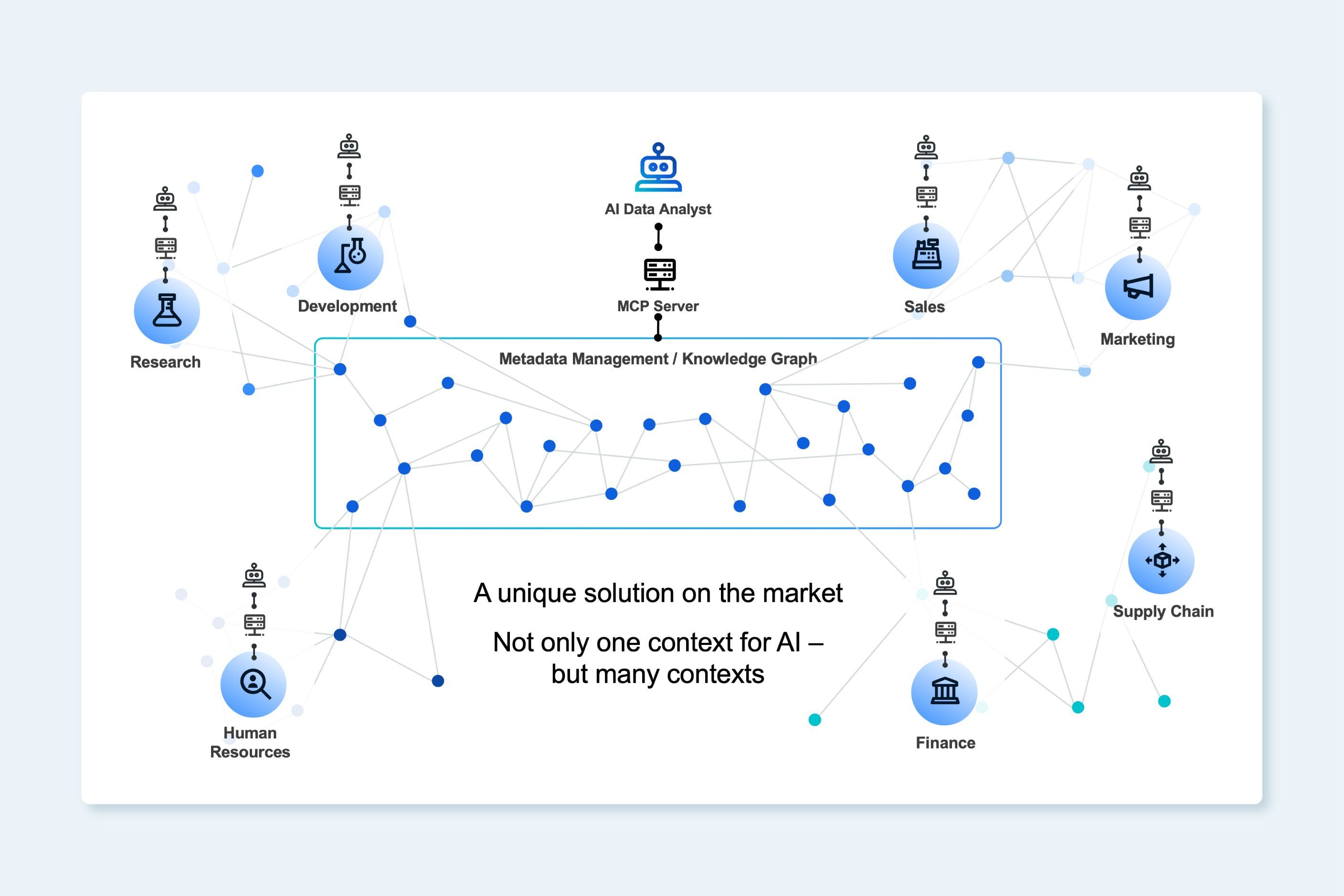
In this episode of Actian Explained I tell you why our federated knowledge graph is a unique offering for AI, because it delivers not one, but many contexts, via MCP.
AI Data analysts are powered by large language models – LLMs. LLMs will increase precision when they are supported by context captured in knowledge graphs. Knowledge graphs solidify the translation of business questions asked in natural language into powerful structured statements for AI Data Analysts that query data and back again to natural language, thanks to the context they contain. And to obtain that context in a way that is fast and predictable, a new standardized approach is gaining momentum: Model Context Protocol (MCP). MCP is an agreed upon standard, that structures and stores data for AI applications.
We enable storing an export of our federated knowledge graph on dedicated Model Context Protocol servers. AI Data analysts and similar applications can query the MCP Server seamlessly, using the MCP protocol, and significantly increase the potential of how they work.
Actian’s federated knowledge graph in the Actian data intelligence platform allow each domain to create their own unique graph and that means that you do not simply get one graph for one context, but a graph that you can filter, allowing for many domain specific graphs for many contexts, because all business domains that have joined the platform have expressed their domain in their unique graph.
This is a completely unique solution, capable of scaling your AI agenda exponentially as the Actian Data Intelligence Platform delivers not one context but many contexts, that will each precisely match the questions you want all your AI Data Analysts to answer.
You will have many AI Data Analysts in your company. They all need unique context to work. Here it is.